Unfortunately
Making sure we understand the rules associated with using commas is essential in English. If you want your writing to flow correctly, yous'll need to understand the comma rules. In this article, we'll await at how commas utilise to the give-and-take "unfortunately" in various ways.
Should I Identify A Comma Earlier Or Later "Unfortunately"?
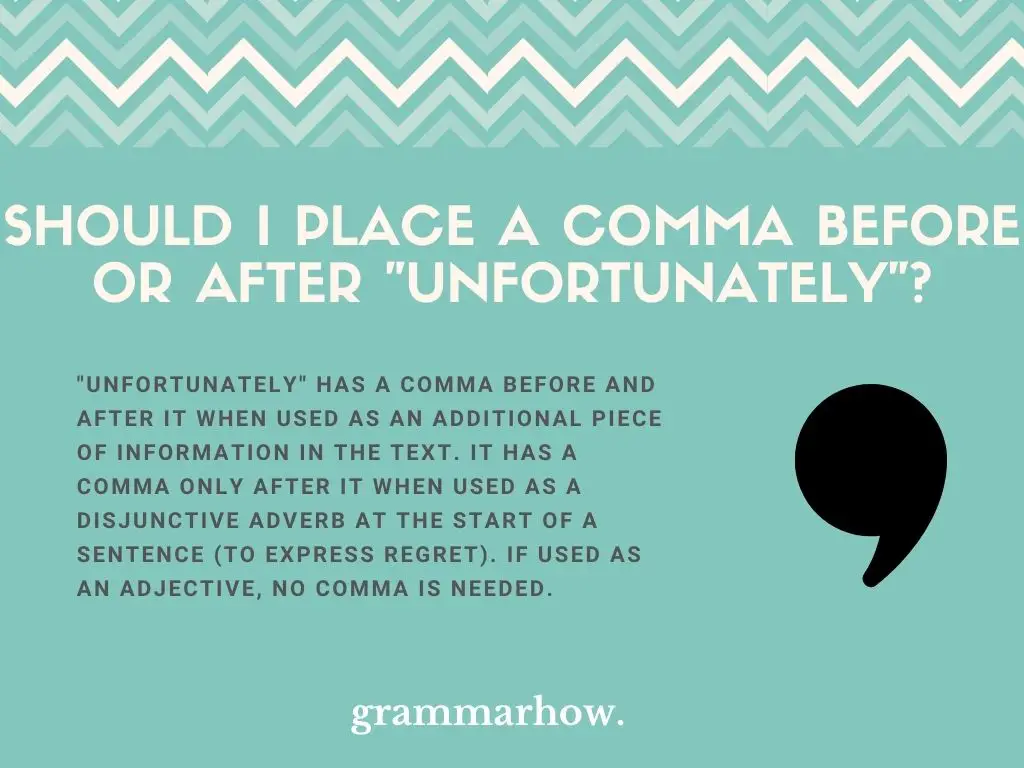
"Unfortunately" has a comma before and after it when used as an additional piece of data in the text. Information technology has a comma only subsequently it when used as a disjunctive adverb at the first of a sentence (to express regret). If used as an describing word, no comma is needed.
Unfortunately, the give-and-take "unfortunately" doesn't come up with unproblematic rules. There are three different variations of information technology which explain how it'south used in unlike situations. Luckily, in one case you've read through this article, you'll have a more than thorough understanding of how information technology works.
According to The Cambridge Lexicon, "unfortunately" is "used to say that something is distressing, disappointing, or has a bad effect."
When Should I Place A Comma Before "Unfortunately"?
So, allow'due south go over each case using "unfortunately" and how comma rules apply to it. Nosotros'll get-go with placing a comma before it to see how it's impacted.
When using a comma before "unfortunately," you must always include a comma after. This turns it into something chosen a parenthetical element (using parentheses just like this).
Sometimes, yous might not include the comma directly afterward "unfortunately." In these cases, it's because there's more to add to the parenthetical element before you lot tin shut it with a comma.
- The new regime, unfortunately elected by the masses, is putting forward seriously devastating agendas.
In this instance, the parenthetical element includes "elected past the masses," so the comma is only used before "unfortunately."
It'south very rare for a instance similar this to come up up, which is why we say it'due south best to always think that a comma is used earlier and afterward "unfortunately" in this case.
The Parenthetical Element
To help you sympathise what we hateful nearly using a parenthetical chemical element, we'll include some examples and discuss them more later.
- He, unfortunately, wasn't feeling well plenty to nourish.
- Yous, unfortunately, have a few weeks left earlier y'all're evicted.
- Sad to say this, simply, unfortunately, nosotros'll have to revoke your rights.
In all of these examples, we're using "unfortunately" as a parenthetical element. You might exist slightly confused by what that word means still, but we have a actually simple solution.
In all of the examples, you can remove "unfortunately" from the sentence and still have it make sense. Yeah, "unfortunately" adds meaning in this way, merely we don't need it for the sentence to work.
- He wasn't feeling well enough to nourish.
- Yous take a few weeks left before you're evicted.
- Distressing to say this, but we'll have to revoke your rights.
As yous tin can meet, we can remove "unfortunately" entirely from the sentence. The general meaning is still conveyed, but that's the crude idea of why nosotros use parenthetical elements. They simply add farther information to the judgement.
When Should I Place A Comma Afterwards "Unfortunately"?
Adjacent, let's get over placing a comma afterward "unfortunately." The same rules apply hither as nosotros mentioned in a higher place since you can't write "unfortunately as a parenthetical element" without including a comma after.
"Unfortunately" is written with a comma after information technology as either a parenthetical element or a disjunctive adverb. A disjunctive is an adverb used at the showtime of a sentence with a comma directly after it.
Some people like to connect adverbs like "unfortunately" to the previous sentence with a semi-colon. Other times, a menstruum is required. In either of these cases, it'southward expert to include a comma subsequently the give-and-take, but plain, there isn't room to use 1 before.
We won't go through using "unfortunately" with a comma earlier and after since we've already covered it in a higher place. We'll focus on using it every bit a disjunctive.
Disjunctive Adverb
A disjunctive adverb is the opposite of a conjunctive adverb. A disjunctive adverb uses a period before it and starts a new judgement. A conjunctive adverb uses a semi-colon before information technology to connect it to the previous clause.
Mostly, a conjunctive describing word tin can also be a disjunctive adjective. "Unfortunately" is more often than not used as a disjunctive, meaning yous can start an entirely new sentence with the adverb "unfortunately" and employ a comma directly after it to convey the emotion.
- Unfortunately, I won't be able to aid you until I return.
- Unfortunately, you can't go along doing this and getting away with it.
- Unfortunately, his begetter passed away not long afterward his sixteenth birthday.
In all of these cases, we start the judgement with "unfortunately." That means we simply need to include a comma after it rather than earlier. Like to the parenthetical chemical element above, we tin still remove the word "unfortunately" and have it hold the aforementioned full general meaning.
- I won't exist able to help you until I render.
- Y'all can't keep doing this and getting away with it.
- His father passed away not long after his sixteenth birthday.
As yous can run across, we can remove "unfortunately" at the start of the judgement here. We include it in the offset place because we use it to limited regret or sadness. Information technology simply adds extra meaning to the whole judgement through a carve up clause.
How Do You lot Use "Unfortunately" In The Middle Of A Judgement?
In that location are a few cases where "unfortunately" is used in the middle of a sentence. The two we want to talk most are using it as a modifier – one for adjectives and the other for verbs.
In both of these cases, no commas are needed when we write "unfortunately." At that place is the instance we explored earlier of using information technology every bit a parenthetical chemical element which also includes information technology in the middle of the sentence.
Notwithstanding, the modifier grade of "unfortunately" works slightly differently.
We employ "unfortunately" as a modifier for a verb or an adjective when we desire to change the meaning slightly to evidence that there is deep regret, sympathy, or sorrow.
Both verbs and adjectives are possible to modify in these cases. You'll oft find "unfortunately" comes directly afterwards the pronoun and directly before the verb or adjective in question.
Verb Examples/Parenthetical Element
Nosotros'll go over some verb modifier examples start of all.
- He unfortunately missed his train by about four minutes.
- She unfortunately got lost.
- I unfortunately need to go home.
In all of these cases, it's possible to use commas equally a parenthetical element or to avoid them completely. This is mostly related to personal preference rather than any detail language rules.
- He, unfortunately, missed his train by nearly four minutes.
- She, unfortunately, got lost.
- I, unfortunately, need to get habitation.
Describing word Examples
- The unfortunately missing boy was finally institute today.
- My unfortunately blind dog is turning 3.
- Her unfortunately deaf child is one of the nicest children I've ever met.
Dissimilar the verb modifier form, in that location is never a case where commas can be used when "unfortunately" is used as a modifier for adjectives. It must also exist kept alone without commas.
Can You Offset A Judgement With "Unfortunately"?
You lot tin can start a sentence with "unfortunately" when y'all're using information technology as a disjunctive adverb. That means that yous kickoff a new judgement and put a comma directly after it. It'south used to add together a meaning of sadness or regret to the following clause.
When used at the start of a sentence, "unfortunately" becomes its own clause. You add a comma to the end of it to showcase this. It's possible to remove information technology and still have the sentence mean the aforementioned thing, though you'll be losing some of the impact and emotion that comes with the word.
Is It Ever Correct To Use "Unfortunately" Without A Comma?
Information technology is correct to use "unfortunately" without a comma in two cases. When yous're using it as a modifier for a verb or an describing word, you lot can write it in the middle of a judgement without a comma.
In the case of using it equally a verb modifier, it's upwardly to the writer whether they want to include commas or not. The following examples signal this:
- Yous, unfortunately, don't take what it takes.
- Y'all unfortunately don't take what it takes.
Both cases are right. The first example is the parenthetical chemical element, where "unfortunately" can be removed. The second example is modifying the verb "don't."
You can also use it as a modifier for an adjective. In this case, it'southward always right to utilise information technology without commas, and you lot can't write it every bit a parenthetical element.
- My unfortunately injured hand is slowly recovering.
Unfortunately – Synonyms
Finally, allow's look at some alternatives to using "unfortunately" that we might exist able to employ in similar ways.
- Sadly
We can limited the sadness in our emotions past using "sadly" instead of "unfortunately." It'southward a more common word to use considering "sad" is the typical emotion we express.
- Regrettably
If we regret the judgement we're about to write, then "regrettably" is likewise a bully word to apply in place of "unfortunately."
You may also similar: 12 Better Words For "Unfortunately" In Formal Emails
Source: https://grammarhow.com/comma-before-or-after-unfortunately/
0 Response to "Unfortunately"
Mag-post ng isang Komento